


"THE FORGOTTEN" VOL. 1: GRETNA
- Caroline Lanier

- Jul 11, 2025
- 5 min read
Updated: Jul 11, 2025
three of diamonds, dedicated to appalachia
For my last project at SCAD, I decided to create a piece that fostered a conversation surrounding the negative stereotypes kept in the minds of outsiders about the people of this country who live a country lifestyle. These people are not lazy, backwards, dumb, or ignorant; instead, they are strong, smart, resilient, and persistent. They may not have attended college, but a degree does not determine anyone's intelligence.

This piece is an attempt to specifically focus on the women of Southern Appalachia who go unnoticed to the outside world, but are immovable forces within their communities. These women work in their gardens, not only for their pure enjoyment, but for the well-being of their families. They cook the best pies you've ever had in your life, and they can scold your behavior entirely with a glare across the room. They always know how to put a baby down to sleep for a young mother, they sing the loudest on Sunday mornings in the back pew, and they're the quietest card sharks you've ever played poker with.
In every aspect of life, these women demonstrate how to conserve resources wisely: nothing—whether food, fabric, paper, or even a single thumbtack—goes to waste. They'll always point out the hole in your dress and demand you let them mend it while you run in the yard with your cousins in your grandpa's old t-shirt and shorts.


This piece began from a prompt in my "Embroidered Opulence" class, instructing us to create something we saw around us. This led me not to recreate a piece of nature or a building I had seen, but to instead use the elements I found around me to tell the story of the people who made Savannah what it is today.

I made this piece using 100% recycled materials found in Savannah, either from second-hand stores or on the ground on my walks to and from my classes at SCAD. I started by taking a stroll through Picker Joe's, located in the Starland District of Savannah. After spending many long Sunday afternoons there, it quickly became my favorite antique store on the coast. I started picking up little metal trinkets originally designed for adorning doors and other household things, acting as a bird attracted to the shiny things. I picked out a fleur-de-lis plaque, keyhole mount, and an ornate gold emblem that resembled a baluster in a staircase.
In another booth, I found a red and white gingham fabric covered in stains from age and screaming about the life it once lived. Eventually, I found the picture of the woman shown in the center. Her eyes looked up and me as if she knew me, and her soft smile accompanied her apparent soft demeanor. I wondered how she got her curls to sit so calmly around her face, and I thought of my own great-grandmother, whom my dad would tell stories of her impeccable hair care routine and everything she did to always maintain it.

I didn't know who this woman was, but I knew exactly who she was. I didn't know where she lived, but I could picture her house. I didn't know what her voice sounded like, but I could hear it perfectly in my mind. I didn't know her religion, but I could hear her singing Baptist hymns on her back porch as she watched the sun set with her husband and her grandkids. I knew her and she knew me.
Afterwards, I found my way down the road in Starlandia. This second-hand thrift store never lets me down when I make it my mission to find the best reclaimed items to add to a piece, no matter what the piece is. Here, I found an offset combination wrench (most likely from an IKEA set), playing cards, thin black wire, silver hoops, and silver cube beads. I also found a piece of scrap wood that would inevitably snap in half as I started to hammer the piece onto the front side. This would lead to me needing to acquire extra wood scraps from my local Home Depot and soak them in coffee to achieve a more "aged" look.
Over the next few days, I would begin to scavenge the streets and sidewalks of Savannah. I

would begin searching for discarded things to incorporate in this piece to bring attention to the discarded memory of this woman who once lived a full life. I would find a blackened washer, a rusted bolt, the slider off a zipper, a piece of tarp from a construction site, and springs from pens covered in dirt thrown to the ground once they were out of ink.
My favorite street find was a broken golden chain with the "G" written on the clasp. This was surely meant to signify the branding, but to me, it was just the letter "G". This led me to decide to name the woman in the photograph "Gretna." This name comes from my mother's side of the family; Gretna was a distant cousin whom I never got to meet. She died from cancer, and in my mind, this woman is her.




The process of making this piece included warping my first tambour embroidery loom, which was just as time-consuming as I would have expected, but not as difficult as I envisioned. It was quite methodical and relaxing to slow down and take my time doing something that would turn out so beautiful. For every piece of embroidery, I used cotton thread from my personal stash or from estate sales. All stitches were pretty basic, apart from the silk-shaded leaf stem coming from behind the photo.

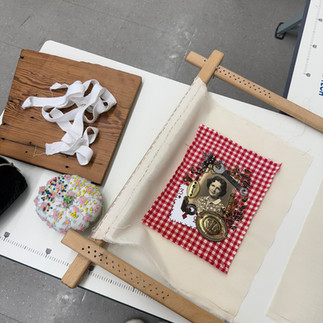


As I made this piece, her story started to reveal itself to me. The wrench, tarp segment, bolt, and washers represented all of the factory workers who live and work throughout Appalachia. The keyhole, baluster-esque piece, and fleur-de-lis represented the front door of her home that was always alive with love. The zipper represented all of the clothes she made for herself and her family. The silver beads and hoops represented how, despite how hard she worked during the week, she still maintained her femininity.


The last element I incorporated was the 3 of diamonds, holding much significance to the piece as a whole. The diamonds represented her femininity and played to her beautiful role as a woman. The number 3 represented the Holy Trinity and her faith in Christ and the way Christianity is so prevelant in Appalachia. The 3 also represented how after merely 3 generations, she was forgotten, and so will all of us. And even though we will be forgotten here on earth, there is a Creator in Heaven who will never forget our name. When we put our faith in Him, our name is written in the Book of Life, and we are permanently on the guest list of Heaven. There is no greater gift than this.

This piece has quickly become my favorite piece I have ever created and has inspired me to create a new collection, dedicated to the Forgotten people across the country, whose pictures end up in thrift stores without stories to be told. I will be creating more of these pieces, telling the story & history of the people & places they're inspired by, dwindling down on my number of states and deck of cards. 50 more states to go & 51 more cards to sew.


Comments